How do you calculate the purchase price per piece?
Divide the pack price by 8. You buy blanks from stock per pack of 8 pieces of one article: a pack of €240 is €30 per piece, a pack of €360 is €45 per piece, both excluding VAT.
With us, there's no price listed with the articles: you request the price for your whole selection and within 1 working day you get the unit price per article, excluding VAT, with the shipping costs in the quote. That unit price depends on your total order.
So the worked examples below use round example amounts, not our prices, and leave out our shipping costs to you: fill in your own quote.
An order is at least 250 euro excluding VAT, and packs of different articles count together towards it. If one pack doesn't reach that minimum, add a second article.
What's the difference between margin and markup?
Markup is your profit per piece as a percentage of the purchase price. Margin is the same profit as a percentage of the selling price. Someone who says they make a 100 percent margin usually means markup. Calculate both excluding VAT; at the same prices, the margin is always lower than the markup.
The same example, two outcomes:
- Purchase price of a pair of trousers (example amount): €30 excluding VAT.
- Selling price: €60 excluding VAT, so €30 profit per piece.
- Markup: €30 divided by €30 is 100 percent.
- Margin: €30 divided by €60 is 50 percent.
Do you calculate your margin with or without VAT?
Without, if you're a VAT entrepreneur. The price you show consumers includes VAT, and according to the Dutch Tax and Customs Administration (Belastingdienst) the standard rate of 21 percent applies to clothing. Of €72.60 in your webshop, €12.60 is VAT that you pay to the Belastingdienst. So first divide every consumer price by 1.21: €72.60 becomes €60.
Only on that amount do you calculate your margin, against a purchase price that is also excluding VAT; otherwise you count €12.60 per piece too much.
As a VAT entrepreneur, in your VAT return you deduct the VAT the wholesaler charges you from the VAT you charge your customers, and you work with €30. If you don't reclaim VAT, for example because you take part in the small businesses scheme (KOR), that VAT is a cost: you work with €36.30 per pair of trousers and €290.40 per pack.
Under the KOR, according to the Belastingdienst, you also charge no VAT to your customers. You then don't divide your selling price by 1.21: your margin is the full selling price minus the purchase price including VAT, in this example €72.60 minus €36.30 is €36.30. If you buy without a KvK registration (Dutch Chamber of Commerce), also read our article on buying wholesale clothing without KvK.
Which costs do starters forget?
The difference between selling price and purchase price is your gross margin, not your profit. Every piece you sell still has costs coming off it. The worked examples below use an assumption per piece sold for that; fill in your own rates.
- Shipping from the wholesaler to you: with us on top of the pack price, 15 euro per box in the Netherlands and 29.99 euro outside it. Divide the amount by the number of pieces in your order and add it to your purchase price per piece.
- Shipping to your customer: your carrier's rate, even if you advertise free shipping.
- Shipping box, packaging and filling material: a few euros per order.
- Your own hangtags: with us from 500 pieces. Print, embroidery and your own neck label aren't possible on stock blanks.
- Transaction fees from your payment provider and the costs of your sales platform: use the rates of your platform.
- Returns: under the statutory cooling-off period, a consumer may cancel an online purchase within 14 days without giving a reason, and then you refund the purchase price and the delivery costs.
- Unsold sizes: a pack holds 1S, 3M, 2L, 1XL, 1XXL. If the XXL doesn't sell, an eighth of your purchase is left over.
- Marketing: ads and photography, divided by the number of pieces you expect to sell.
How much margin is there on trousers?
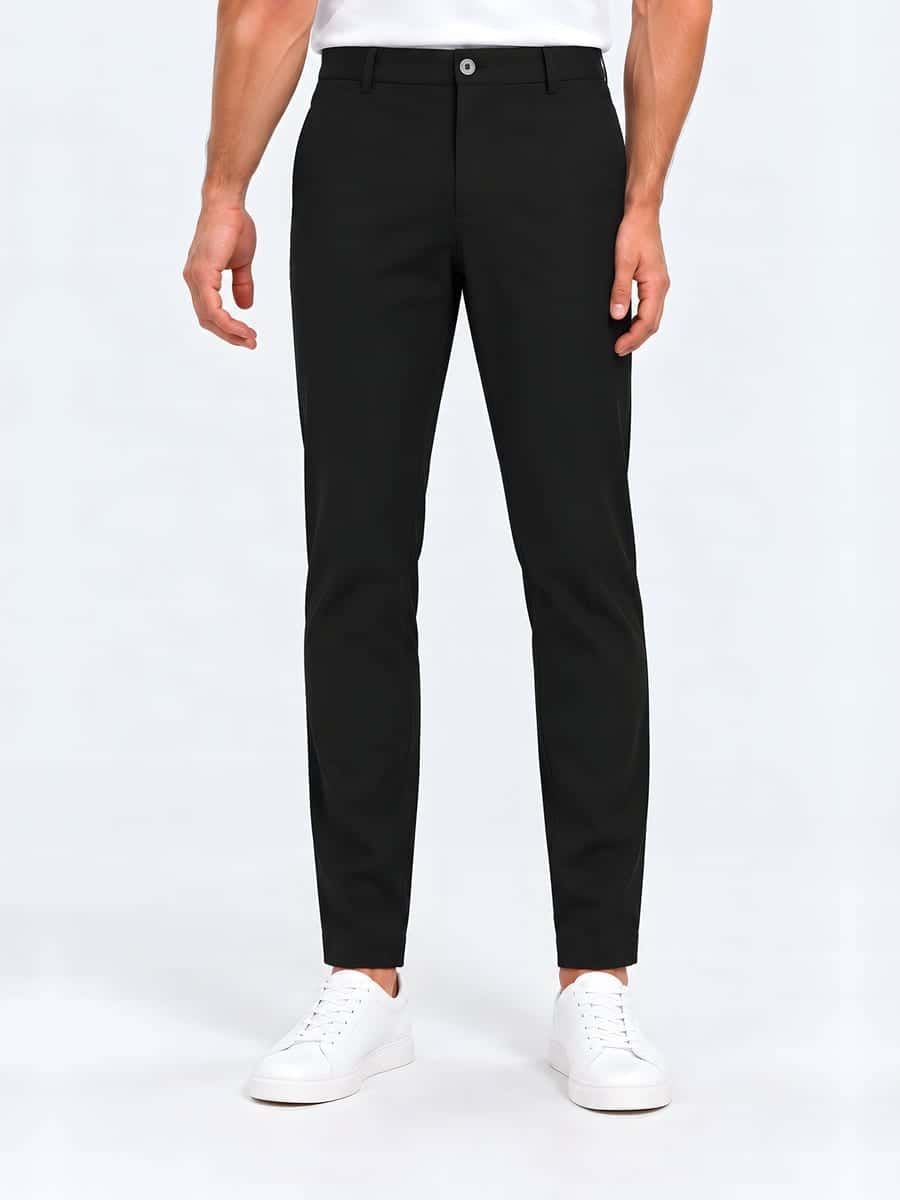
A pack of 8 pairs of trousers at €30, an example amount to calculate with and not our price, costs €240 excluding VAT. You list them in your webshop for €72.60 including VAT and estimate the costs per piece sold (shipping, packaging, transaction fees and a share of marketing) at €12. You calculate as a VAT entrepreneur, so excluding VAT.
- Selling price excluding VAT: €72.60 divided by 1.21 is €60.
- Gross margin per piece: €60 minus €30 is €30, 50 percent of the selling price.
- Net margin per piece: €30 minus €12 costs is €18.
- Net margin per pack if all 8 sell: 8 times €18 is €144.
- What each piece sold brings back towards the purchase: €60 minus €12 is €48.
- Break-even: €240 divided by €48 is 5, so with the fifth piece sold your purchase is paid back (5 times €48 is €240).
- If one piece is left over, you sell 7: 7 times €48 is €336, minus €240 is €96 profit instead of €144.
How much margin is there on tech suits?
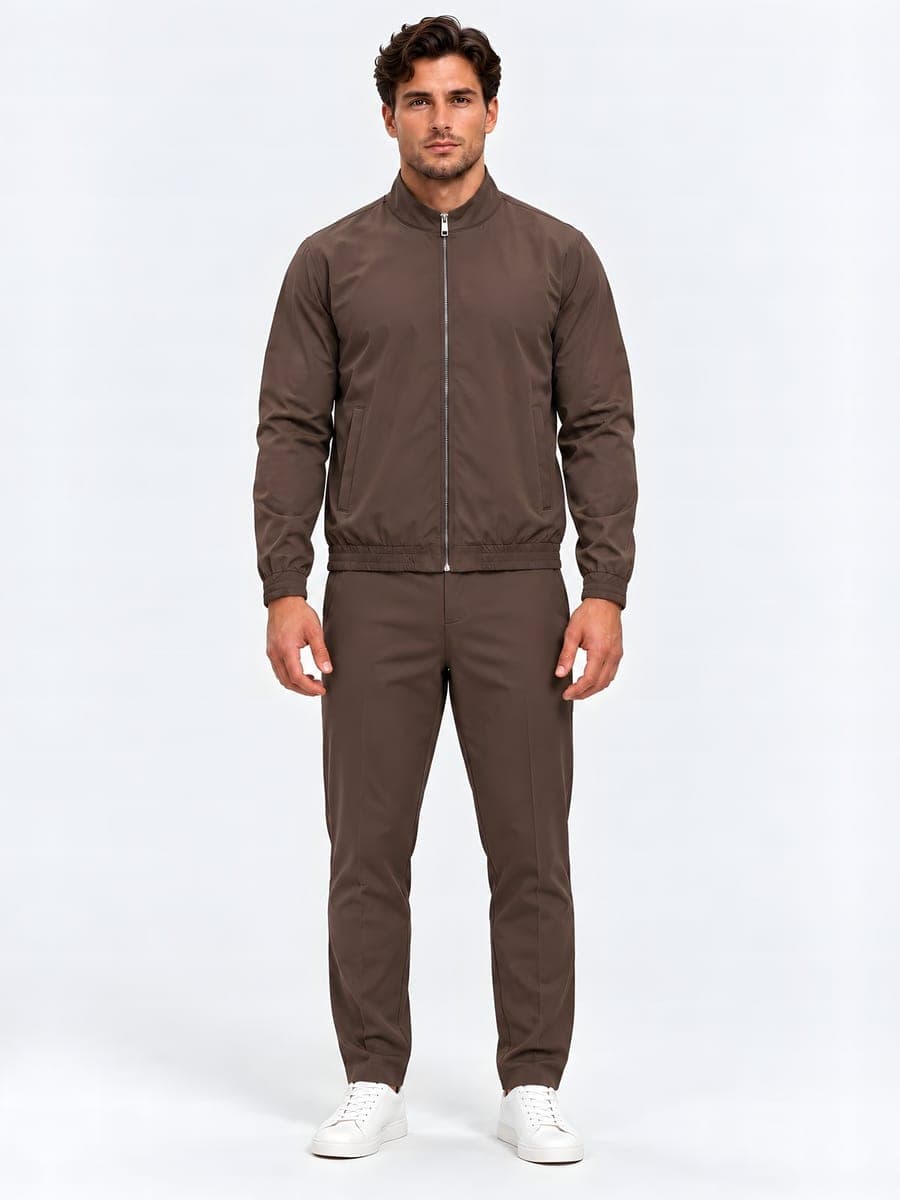
A tech suit is a set of jacket and trousers. A pack of 8 sets at €45, again an example amount and not our price, costs €360 excluding VAT. You sell the set for €108.90 including VAT and count €15 costs per set sold: the box is bigger and the shipping rate higher than for a shirt.
- Selling price excluding VAT: €108.90 divided by 1.21 is €90.
- Gross margin per set: €90 minus €45 is €45, 50 percent.
- Net margin per set: €45 minus €15 is €30.
- Net margin per pack with 8 sets sold: 8 times €30 is €240.
- Each set sold brings back €90 minus €15 is €75.
- Break-even: €360 divided by €75 is 4.8, so with the fifth set (5 times €75 is €375) your purchase is paid back.
How much margin is there on shiny tees?
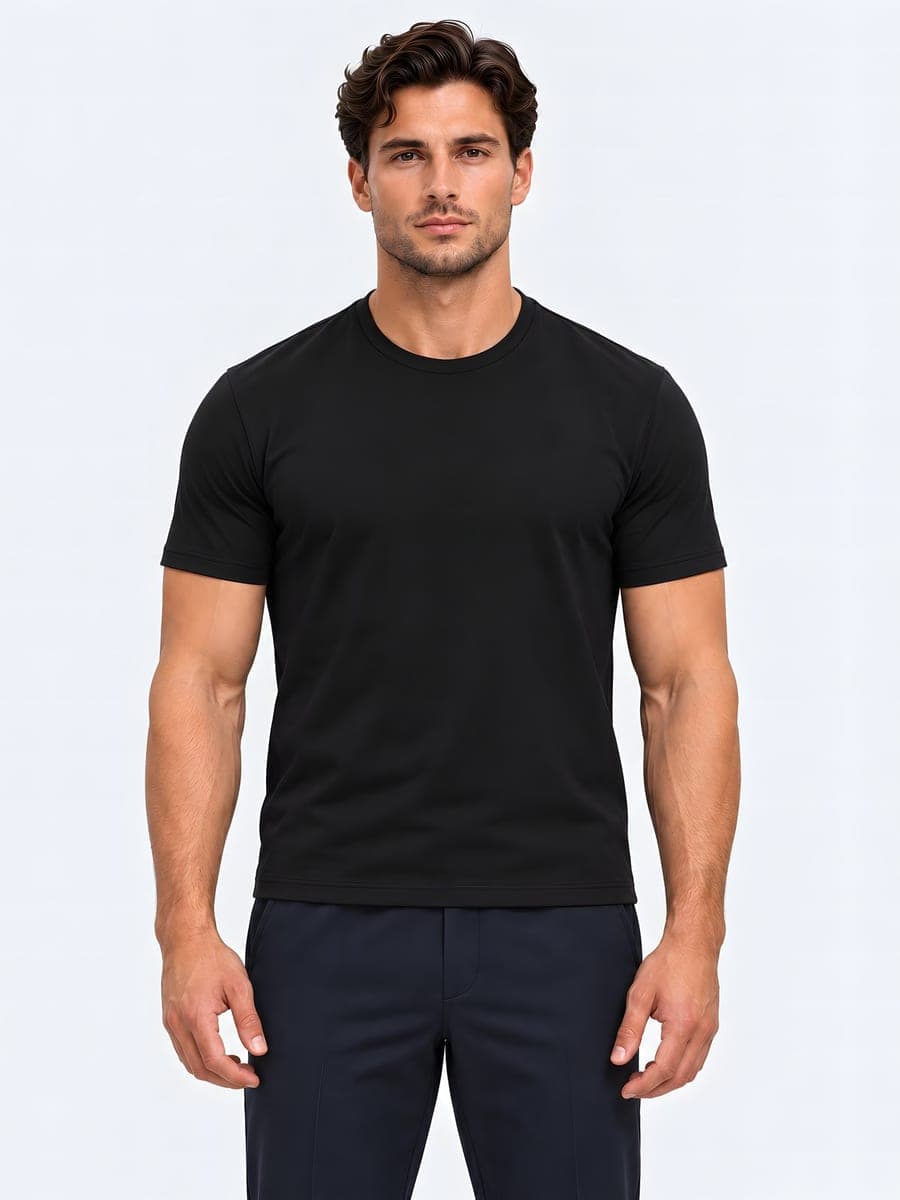
A pack of 8 shiny tees at €15, an example amount and not our price, costs €120 excluding VAT. That's below the minimum per order, so you combine it with another pack. You sell the shirt for €36.30 including VAT, which excluding VAT is double the purchase price, and count €8 costs per piece sold.
The gross margin as a percentage is just as high as that of the trousers. Yet the costs per piece weigh more heavily on a cheap article: you have to sell 6 of the 8 shirts to break even, against 5 of the 8 pairs of trousers.
- Selling price excluding VAT: €36.30 divided by 1.21 is €30.
- Gross margin per piece: €30 minus €15 is €15, exactly 50 percent.
- Net margin per piece: €15 minus €8 is €7.
- Net margin per pack with 8 shirts sold: 8 times €7 is €56.
- Each shirt sold brings back €30 minus €8 is €22.
- Break-even: €120 divided by €22 is 5.5, so only with the sixth shirt (6 times €22 is €132) is your purchase paid back.
How do you calculate your selling price?
As a starting point, take a factor of 2 to 2.5 on the purchase price excluding VAT; the VAT comes on top of that. It's a rule of thumb for your own sum, not a norm and no guarantee that your customers will pay that price. A pair of trousers at €30 then becomes €60 to €75 excluding VAT, about €73 to €91 including VAT.
Apply that factor to what you realistically sell, not to the whole pack. If two pieces are left over in the trousers example, the profit on the pack is more than halved: 6 times €48 is €288, minus €240 is €48 instead of €144. If you expect to sell 7 of the 8, apply the factor to €34.29 per piece: the pack price divided by 7.
What do you check before you order?
Run through this list, and your sum still adds up after the first sale:
- You work with the unit price from your quote, not with an estimate.
- The shipping costs from the quote are in your purchase price per piece.
- You choose one VAT route: as a VAT entrepreneur everything excluding VAT, otherwise the full selling price against the purchase price including VAT.
- Your costs per piece sold are included, with the real rates of your carrier, payment provider and platform.
- You know after how many of the 8 pieces your purchase is paid back.
- The size split we confirm with your request suits your customers.
- Your order reaches the minimum of 250 euro excluding VAT, with several packs if needed.